
Table of Contents
- What Lumbar Support Actually Does for Your Back
- Ergonomic Camping Chairs for Seniors: What to Look For
- The Best Camping Chair for Bad Backs Australia: Features That Matter
- Compact Camping Chair Weight Capacity and Stability Explained
- Portability vs Comfort: Why You Cannot Always Have Both
- Frame Construction and Materials That Last
- Setup and Pack-Down for Stiff Backs and Sore Hands
- How to Choose a Comfortable Camping Chair With Lumbar Support
- Frequently Asked Questions
Last Updated: September 19, 2026
What Lumbar Support Actually Does for Your Back
A comfortable camping chair with lumbar support is a folding chair built with a curved or padded lower-back section that follows the natural inward curve of your spine. That curve is called the lumbar lordosis, and holding it while you sit takes pressure off the discs and muscles in your lower back.
Here's the thing most chair roundups skip. A standard camp chair lets your pelvis roll backwards and your lower back round out. Twenty minutes is fine. Two hours and you feel it. At Old Mate Camping Co., we build one chair properly.
The Australian Institute of Health and Welfare reports on back problems show how common back pain is across the country. So it's worth getting the seat right.
Ergonomic Camping Chairs for Seniors: What to Look For
Older backs and older hips have a different set of demands to a twenty-year-old spine. The chair that suits a teenager at a music festival is not always the chair that suits someone managing arthritis, a replaced hip or a long-standing lower back issue. The good news is the priorities are simple once you know what you are looking at.
Start with seat height. A seat that sits too low forces you to haul yourself up using your knees and lower back, which is exactly the movement most older bodies are trying to avoid. A seat that is slightly higher lets your feet rest flat and your thighs take the load when you stand. If you can sit down and stand up without gripping the armrests, the height is about right.
Next, backrest angle. A backrest that is bolt upright pushes your head forward and loads your neck. A backrest that reclines too far makes standing up harder. The sweet spot is a gentle recline, enough to let your shoulders relax without turning the chair into a hammock.
Armrests matter more than most people expect. Padded armrests give you something to push against when you stand, which takes load off your knees and lower back. Firm armrests are better than soft ones for this job. Soft padding feels nice but compresses when you lean on it.
Then there is the frame. A frame that flexes or wobbles when you shift your weight is unsettling, and it makes you tense up to stay balanced. A solid frame lets you relax into the seat, which is the whole point.
A few things worth checking before you buy:
- Seat height that lets your feet sit flat on the ground
- A backrest that reaches your mid-back at minimum
- Padded armrests for pushing up out of the seat
- A frame that does not flex or wobble when you shift weight
- A seat that stays taut rather than sagging under you
Getting out of a low, saggy chair is half the battle for stiff hips and knees. A slightly higher seat and solid armrests make a real difference, and they are worth more than any amount of extra padding.
If you mostly sit in one spot and space is not tight, a larger padded chair with a higher seat can be a great choice. If you need something you can carry and pack easily, a compact chair with a firm backrest does the job well.
The Best Camping Chair for Bad Backs Australia: Features That Matter
The best camping chair for bad backs Australia sells is one that holds its shape and supports your lower back for the whole sit, not just the first ten minutes.
Look for these features:
- Adjustable tension or firm lumbar padding so the support doesn't collapse under you
- A backrest angle that's slightly reclined, not bolt upright
- Breathable mesh or ripstop fabric so you don't overheat and shift around
- A stable frame that won't tip when you lean back
Compact Camping Chair Weight Capacity and Stability Explained
Weight capacity and stability are two different things, and both matter. Capacity is the load the frame is rated to hold. Stability is how well the chair stays planted when you lean, twist or stand up.
The Old Mate Original is rated to 150kg. If you're on the heavier end, a chair with a higher rating gives you more margin and less flex under you.
Stability comes down to a few design choices:
| Feature | Why It Matters | What to Look For |
|---|---|---|
| Wider feet or base | Spreads load, resists sinking | Broad contact points |
| Frame geometry | Prevents tipping when leaning | Low centre of gravity |
| Hub and joint quality | Stops wobble over time | Tight, solid connections |
| Fabric tension | Keeps you from sagging | Firm, taut seat |
A chair that sags pulls your hips forward and undoes the lumbar support. Tension matters as much as the padding.
Portability vs Comfort: Why You Cannot Always Have Both
Big padded chairs are genuinely comfortable. They're also heavy and take up half the boot. That's not a flaw, it's a trade-off, and for a week at the same campsite a big chair is a great choice.
The other end of the scale is a chair that packs down small and light. The Old Mate Original weighs 1.8kg and folds to 44cm by 8cm, about the size of a drink bottle.
You can't have a thick padded recliner and a bottle-sized pack. Pick the job you need it for.
Frame Construction and Materials That Last
Most camping chair guides tell you aluminium is lighter than steel and ripstop is tougher than plain nylon. That is true, but it does not tell you much about how a chair actually holds up over years of use. The more useful question is where chairs tend to fail, and what that means for the lumbar support you paid for.
Start with the frame. Aluminium resists corrosion and stays light, which is why it suits coastal trips and wet seasons. Steel is strong and can be a good fit for a chair that lives in one spot. Both are fine materials. The difference shows up in the joints and hubs, which is where folding chairs usually give trouble first.
A hub is the pivot point where the frame legs meet. On a well-built chair, the hub is tight and the rivets or pins are solid. On a chair that has been used hard, a loose hub lets the whole frame twist slightly every time you sit down. That twist is small, but over a season it adds up. You feel it as a chair that wobbles when you shift your weight, and wobble is the enemy of lumbar support because it stops you relaxing into the backrest.
Fabric is the other half of the story. Ripstop nylon resists tearing because the woven grid stops a small nick from running. It also holds tension well, which matters because a seat that sags pulls your hips forward and undoes the lumbar curve. Breathable mesh keeps air moving in summer, which is worth thinking about if you camp in the heat. A mesh seat is cooler. A ripstop seat is more durable. Some chairs combine both.
Here is the part most guides skip. Lumbar support systems degrade in two ways. The first is foam compression. Soft foam pillows flatten over months of use, and once they flatten they stop holding your lower back. Firm foam or a shaped panel holds its shape far longer. The second is strap tension. Adjustable lumbar straps rely on elastic or webbing that stretches over time, so a strap that felt firm in the first year can feel slack by the third. If you want support that lasts, look for a firm shaped backrest rather than a soft pillow or a stretchy strap.
A simple way to check a chair before you commit to it:
- Press the lumbar section firmly. If it gives easily, it will flatten.
- Twist the frame gently. If it flexes, the hubs are loose.
- Sit and shift your weight side to side. A stable chair stays planted.
- Check the fabric tension. A taut seat holds your posture.
None of this is about brand. It is about materials and construction, and it applies to any chair you look at. If you want a chair that will still feel the same in three years, spend your attention on the hub, the fabric tension and the firmness of the lumbar section. Those three things tell you more than the label.
Setup and Pack-Down for Stiff Backs and Sore Hands
Setup and pack-down should take seconds, not minutes. If you've got a stiff back or sore hands, fiddly clips and poles are the last thing you want after a long drive.
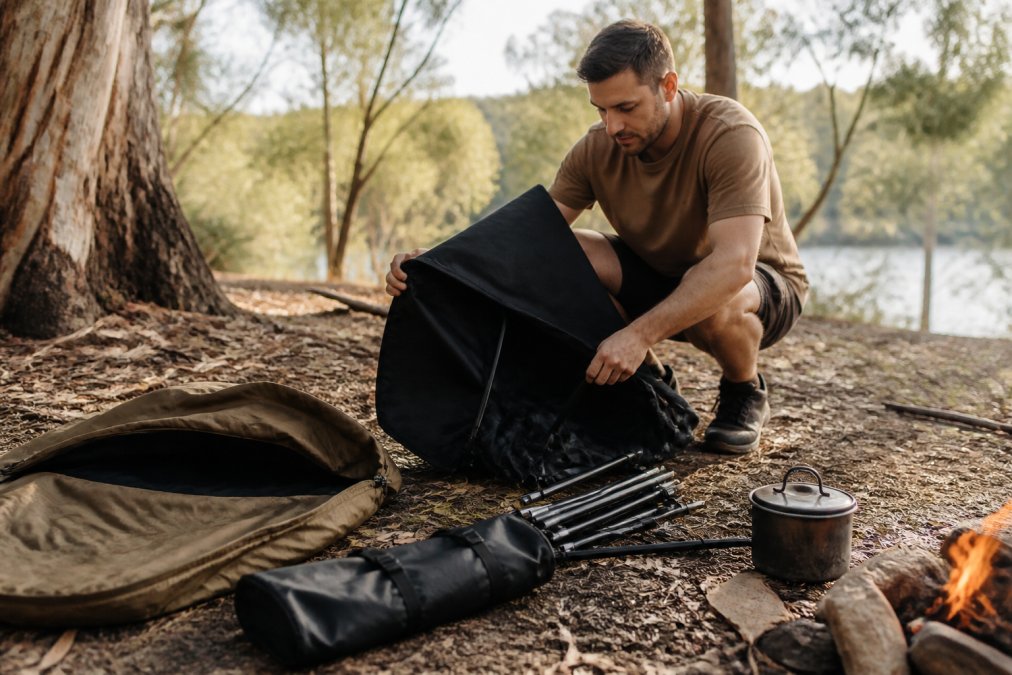
Look for a chair that opens and folds in one motion, with no separate poles to slot together. The Old Mate Original sets up in seconds with no instructions needed.
How to Choose a Comfortable Camping Chair With Lumbar Support
Choosing well comes down to matching the chair to how you'll use it. Here's a simple way to decide:
- Weigh your priorities: boot space, carry weight, or maximum padding
- Check the weight capacity against your own weight, with margin
- Confirm the lumbar section is firm, not soft foam
- Test the seat height and armrests for easy standing
- Check the packed size against your actual storage space
- Look at the frame material for the conditions you camp in
If you mostly camp in one spot and space isn't tight, a large padded chair will serve you well. If you're short on space, moving around, or carrying gear any distance, a compact chair is the smarter pick.
For a chair that covers the compact end of that range, see the [Old Mate Original compact camping(/blogs/news/do-compact-camping-chairs-provide-support) chair | oldmatecampingco.com.au].
Frequently Asked Questions
What features provide the best lumbar support in a camping chair?
Look for a backrest that curves to match the natural inward curve of your lower spine, not just a flat panel with padding. Adjustable tension straps let you firm up or soften the support, and a seat height that keeps your knees level with your hips helps too. Breathable mesh matters on hot days because it stops you sweating against the fabric. A chair that holds its shape over time, like one with an aluminium frame and ripstop nylon seat, keeps that support consistent season after season.
Are compact camping chairs comfortable for long periods?
They can be, if the design puts thought into back support rather than just shrinking a standard chair. The trade-off is usually padding: a compact chair has less foam than a big padded lounger, so it relies on seat shape and backrest angle instead. For a few hours at the footy or an evening around the fire, a well-made compact chair with lumbar support holds up fine. If you want to sink into deep cushioning for a full day, a larger chair suits that job better.
How does weight capacity affect the stability of a camping chair?
A higher load-bearing capacity usually means a stronger frame and wider feet, which keeps the chair planted on soft ground. Check the rated figure against your own weight and leave some headroom rather than sitting right at the limit. The Old Mate Original is rated to 150kg, which gives most people a comfortable margin. Frame material matters as much as the number: aluminium keeps the weight down while still handling the load, and corrosion-resistant finishes help it last through coastal trips.
What should I look for in a camping chair if I have back pain?
Prioritise backrest angle and support over padding. A slight recline takes pressure off your lower spine, and a curved backrest encourages better spinal alignment than a flat one. Check the seat height so getting up is not a struggle, and test the armrests, since padded armrests help you push yourself upright. Setup ease matters too if bending over is painful. If your back pain is ongoing, speak to your physio about what seating position works for you before you buy.
Back pain doesn't have to end your camping trips, but the wrong chair will cut them short. At Old Mate Camping Co., we built the Old Mate Original for people who need real support without the bulk: a 150kg weight capacity, a 1.8kg aluminium frame, and a pack size of 44cm by 8cm that fits where other chairs won't. It sets up in seconds, so you can stop fiddling and start sitting. Get started with Old Mate Camping Co. and take a chair that looks after your back.