
Table of Contents
- Why Quick Setup Chairs Matter on the Sideline
- Feature Comparison: What to Look For in Sideline Seating
- Compact Camping Chair Weight Capacity: What 150kg Really Means
- Portable Chair Setup Time: What to Expect in Practice
- Lightweight Sideline Chairs for Netball, Footy and Cricket
- Comfort and Support for Long Days at the Ground
- Looking After Your Chair: Maintenance and Cleaning
- How Terrain Affects Chair Performance
- Frequently Asked Questions
Last Updated: September 11, 2026
Why Quick Setup Chairs Matter on the Sideline
The drive takes an hour. Finding a park takes twenty minutes. Then you're on the boundary holding a chair bag, a coffee and a gear bag while the game is already into the first quarter.
Quick setup chairs for sports parents solve one problem: getting you seated before the first whistle instead of after it. This guide covers what matters when choosing a sideline chair, from packed size and weight to setup time and comfort across a full day.
Most parents don't need a chair that survives a month in the Simpson Desert. They need one that lives in the boot, comes out easily and doesn't fight back when you open it. Here's what to check, what the numbers mean, and how to pick a chair that suits your Saturdays.
Feature Comparison: What to Look For in Sideline Seating
Sideline seating is portable seating you carry to and from a ground, set up quickly and sit in for a full game or longer. The features that matter most are packed size, weight, setup mechanism and seat support.
Here's how the main considerations stack up:
| Feature | What to Check | Why It Matters |
|---|---|---|
| Packed size | Length and width when folded | Fits in the boot alongside kids' gear |
| Weight | Kilograms, including carry bag | Easier walk from the car to the boundary |
| Setup | Fold-down mechanism, no loose parts | Seated before the game starts |
| Seat support | Frame shape, seat height | Comfort across a long day |
| Fabric | Ripstop nylon or canvas | Handles sun, dew and light rain |
| Weight capacity | Load-bearing rating | Confidence for bigger adults |
Packed Size and Boot Space
Packed size decides whether the chair makes it to the ground. A chair that folds to roughly the size of a drink bottle slides into gaps a full-size folding chair can't.
Think about what's already in your boot: school bags, a pram, cricket kit, groceries. Compact storage is the difference between a chair that lives in the car and one that gets left at home.
Weight and Carry Comfort
Weight matters most on the walk from the car park. A frame around 1.8kg is easy to carry in one hand alongside a coffee and a gear bag.
Check the carry bag too. A shoulder strap or a grab handle makes a real difference when you're juggling three other things.
Compact Camping Chair Weight Capacity: What 150kg Really Means
A 150kg weight capacity means the chair is rated to hold an adult up to 150 kilograms, well above the average adult weight.
What matters is how the rating is built. A load-bearing frame with reinforced brackets spreads weight through the base rather than concentrating it at the joints. Aluminium handles this well because it's light without being weak.
If you're on the heavier end, look for a stated capacity rather than a vague "sturdy" claim. A number you can check beats marketing language every time.
Portable Chair Setup Time: What to Expect in Practice
Portable chair setup time is how long it takes from pulling the chair out of its bag to sitting in it. Good designs take seconds.
The chair that wins here has no separate poles, no clips to line up and no instructions needed. You unfold it, the frame locks, you sit down.
If you've spent ten minutes fiddling with clips on a "quick setup" chair before, you know the difference. Look for a fold-down mechanism where the frame does the work.
Lightweight Sideline Chairs for Netball, Footy and Cricket
Lightweight sideline chairs are built for the parent who moves between courts and ovals all weekend. Netball Saturday morning, footy in the afternoon, cricket on Sunday. The chair needs to keep up.
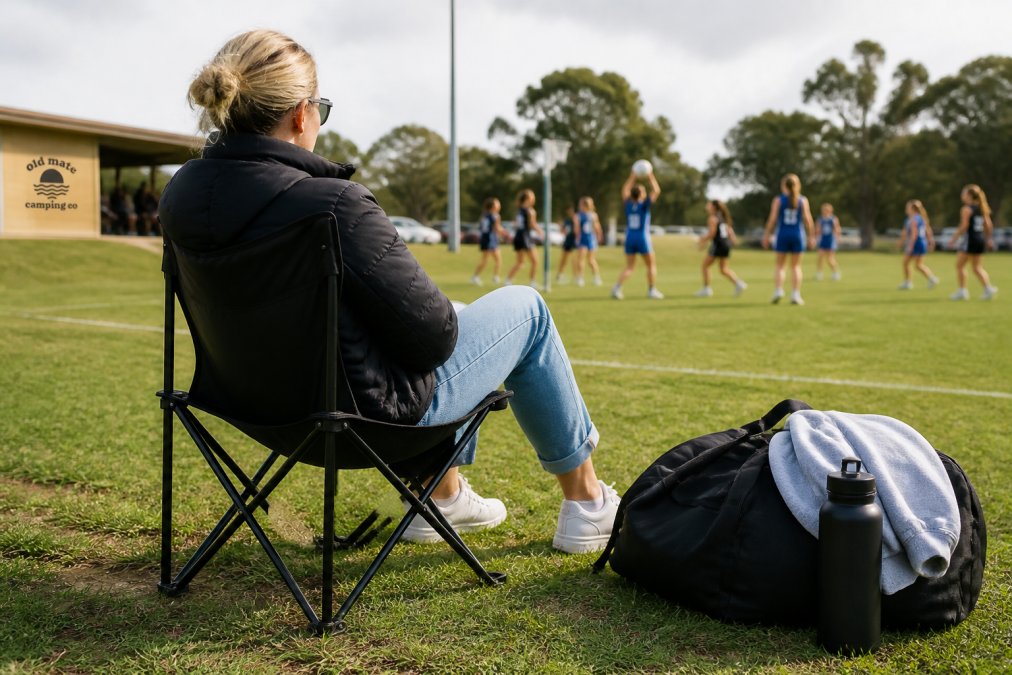
The Old Mate Original weighs 1.8kg and packs to 44cm by 8cm, so it fits in the boot without a fight. It sets up in seconds with no instructions, which matters when you're walking in as the teams warm up.

For tournament days, when you're at the ground from morning to late afternoon, a chair you can carry without thinking about it is the one you'll keep bringing.
Comfort and Support for Long Days at the Ground
A game lasts an hour. A tournament day lasts eight. Those are two different comfort problems, and most guides only solve the first.
Why hour eight feels different to hour one
Sitting is not rest. The load moves from your feet to your backside and lower back, and the muscles that hold your spine upright switch off (the NIH). After a while the tissue under your sit bones takes the pressure and your lower back aches from being held in one position. On a soft couch you sink and the load spreads. On a firm seat the pressure concentrates.
That is the trade-off with any compact chair. A firm, taut seat gives you support and keeps you off the ground, but it does not mould to you the way a big padded lounger does. Knowing that up front is half the battle.
Seat height and getting up again
Seat height is the most underrated comfort spec. A very low seat is fine for ten minutes and miserable by the fourth quarter, because every time you stand up to cheer you're pushing up from close to the ground. A seat height that lets you stand with a normal push is worth more across a day than an extra centimetre of padding.
Back support: what a compact chair can and cannot do
A compact chair with a shaped backrest gives you support through the mid back. It will not give you the deep lumbar curve of a big padded armchair, and we won't pretend otherwise. If you have a sensitive lower back and you're sitting for eight hours, a larger chair designed for lounging is genuinely the better choice. That's a different job, and a good one.
If you want to make a compact chair work for a long day, the fix is simple. A rolled towel or small cushion tucked into the small of your back restores the curve the seat does not provide (mayoclinic.org). It weighs nothing and changes how the whole day feels.
Ventilation on hot days
Breathable fabric matters more than people think. On a thirty degree day a solid seat traps heat and moisture against your legs, while a breathable seat lets air move (the CDC). Ripstop nylon is light and dries fast, which helps on dewy mornings and after a light shower. It's not a cooling system, but it's the difference between a damp seat and a dry one.
Small habits that add hours
- Stand up at every break. Even thirty seconds resets the pressure on your sit bones.
- Shift your weight side to side now and then rather than sitting dead still.
- Keep your feet flat and your knees roughly level with your hips where the ground allows.
- Bring water. Stiffness and dehydration travel together.
- If you are at the ground all day, take a walk to the car or the canteen between games. Movement is the best thing you can do for a back that has been sitting.
Matching the chair to the day
For a single game, almost any decent sideline chair will do. For a full tournament day the priorities shift. You want a seat height you can get out of easily, a backrest that supports your mid back, breathable fabric, and a chair light enough to carry between courts without it being a chore. If lower back support is the deciding factor, look at a larger chair built for lounging. If your day involves moving between three venues, a compact chair you can carry in one hand is the one still with you at the last game.
Looking After Your Chair: Maintenance and Cleaning
A quick clean after each use keeps the fabric and frame in good shape for years. Wipe the frame with a damp cloth, shake out the seat, and let it dry fully before packing it away.
Avoid leaving a wet chair folded in the boot. Moisture trapped against ripstop nylon and aluminium shortens the life of any outdoor chair.
Check the joints and brackets every few months. A quick tighten of any moving part keeps the fold-down mechanism working smoothly.
How Terrain Affects Chair Performance
Most sideline chair guides treat the ground as an afterthought. In practice, the surface under you changes how a chair behaves more than almost any other variable, and it changes week to week. Netball courts, footy ovals, cricket grounds and the gravel strip beside the car park all ask different things of the same chair.
Here is how the main surfaces play out.
Hard courts and synthetic surfaces
Netball courts and synthetic turf are firm and flat, which is the easy case. The main issue is scratching. Grit works its way into feet and joints over a season, so a quick wipe after each use keeps the fold-down mechanism running smoothly. Firm ground also means you can sit right on the edge of the court without the chair shifting.
Grass ovals
Grass is the middle case. A mown oval is flat enough for almost any chair, but the boundary line is usually where the ground falls away. A chair with a wider footprint spreads load across more contact points, which keeps it stable when one leg is on a slight slope. On a slope, face the chair across the fall rather than down it. It's a small thing that stops you sliding forward all game.
Mud and soft ground after rain
This is where narrow legs struggle. On soft ground, feet sink, and a chair that sinks on one corner will rock for the whole match. Two fixes. Position the chair on the firmest patch you can find, usually higher ground or near a tree line where roots hold the soil. Then spread the load. A flat, wide foot has less pressure per square centimetre than a narrow one, so it sits on top of soft ground rather than cutting in.
If the ground is going to be boggy, a chair with a wider base is the better pick for that day. It's a different job to a compact chair, and worth having both if you're at the ground every weekend.
Bleachers and hard seating
Some grounds only offer bleachers or concrete steps. A compact folding chair is not the right tool there, and we'll say so plainly. What you want on bleachers is a stadium seat with a backrest that clips or straps to the bench. They're a genuinely good option for that setting. A ground chair is for the sideline, not the stand.
Dew, cold grass and ground clearance
Early morning netball and winter footy mean wet grass. A seat height that keeps you clear of the grass line matters more than people expect. Sit too low and you're dealing with a damp backside by half time. Ground clearance also keeps you off cold ground, which is the difference between sitting through the last quarter and giving up at three quarter time.
A quick way to read the ground before you set up
Walk the spot first. Press a heel into the grass. If it sinks, expect the chair to sink too, and move to firmer ground. If the surface is hard and gritty, check your feet for grit before you pack away. If it's sloped, sit across the slope, not down it. Thirty seconds of reading the ground saves you a match of fidgeting.
Frequently Asked Questions
What features should sports parents look for in a portable chair?
Focus on packed size, weight and setup speed. A chair that folds to 44cm long and 8cm wide fits easily in a wagon boot alongside kids' gear. Look for a weight around 1.8kg so you can carry it one-handed with a bag. Check the weight capacity suits every adult who might use it. Aluminium frames keep things light, and ripstop nylon holds up to weekly use. A carry bag makes transport easier.
How much weight should a portable sports chair support?
Aim for at least 120kg if multiple adults will share the chair. The Old Mate Original is rated to 150kg, which gives bigger blokes room to sit without worrying. Check the frame material and reinforced brackets, since these decide how the chair handles repeated load. A higher capacity does not add much weight if the frame is aluminium. Match the rating to the heaviest person who will use it.
Why is packed size important for sideline seating?
Most sports parents are already carrying kids, gear bags and sometimes a dog. A chair that packs to drink-bottle size, like 44cm by 8cm, slides into gaps in the boot or straps to a backpack. That means you actually bring it rather than leaving it at home. Smaller packed size also makes it easier to carry from the car park to the ground, especially when you are juggling other things.
How do you maintain a camping chair used for weekly sports?
Wipe the frame with a damp cloth after wet-weather games to stop mud drying in the joints. Check the ripstop nylon seat for grit and brush it off before folding. Let the chair dry fully before storing it, since damp fabric can get musty. Store it in the carry bag in a dry spot. Every few months, check the brackets and hinges for looseness. These small habits keep the chair working for seasons.