
Table of Contents
- What Actually Matters in a Portable Camping Chair
- Lightweight Camping Chairs for Hiking: What to Look For
- Camping Chair Weight Capacity Guide
- Comfort and Support for Longer Sits
- Compact vs Full-Size: Which Chair Suits Your Setup
- Climate and Ground Conditions: What Survives an Aussie Summer
- Frequently Asked Questions
Last Updated: September 12, 2026
What Actually Matters in a Portable Camping Chair
If you are shopping for the best portable camping chairs 2026, the spec sheet that matters most is packed size and carry weight, not seat width. A chair is only portable if you actually take it with you. At Old Mate Camping Co. we have watched plenty of good chairs stay in the garage because they were a pain to pack.

A portable camping chair is a foldable seat designed to collapse into a compact carry bag, usually weighing under 2kg and packing to roughly the size of a drink bottle or small duffel.
Three things decide whether a chair earns its spot in the boot:
- Packed size. Where does it sit when the car is already full?
- Carry weight. Can one person walk it from the car to the campsite?
- Setup time. How long before you are actually sitting down?
Everything else, cup holders, side pockets, reclining mechanisms, is a bonus. Get these three wrong and the chair stays home.
Lightweight Camping Chairs for Hiking: What to Look For
Lightweight camping chairs for hiking need to disappear into a pack. The chair you carry on a walk has to justify every gram. If it is heavy or awkward, it stays in the car.
Packed Size and Carry Weight
Packed size is the length and width of the chair once folded, usually quoted in centimetres. Carry weight is what it adds to your pack in kilograms.
For backcountry trips, look for a chair under 2kg that packs to about the length of a drink bottle. The Old Mate Original weighs 1.8kg and packs to 44cm by 8cm, so it fits in a daypack side pocket or straps to the outside of a larger pack.
Ultralight chairs save weight by using a simple frame and tensioned fabric seat. That trade-off is real: less padding, lower seat height, and less lumbar support than a car camping chair. For a short rest stop, that is fine. For a full evening around the fire, you may want more.
Camping Chair Weight Capacity Guide
Weight capacity is the maximum load a chair is rated to hold. It is the number to check first if you are on the heavier side, tall, or planning to share the chair with a kid on your lap.
Most compact chairs are rated somewhere between 100kg and 150kg (choice.com.au). The Old Mate Original is rated to 150kg. That rating is not just about the seat fabric. It covers the frame, the seat, the joints and the feet together, so a higher number usually means a stronger aluminium frame and a more reinforced seat base.
What the rating actually covers
A weight rating is a static test figure. It assumes the chair is on flat, firm ground, the load is centred, and the chair is set up correctly. Real life is messier than that.
- Frame. Aluminium alloy handles repeated setup and pack-down better than thin steel, and it does not rust. That matters if the chair lives in a ute tray or a boat.
- Joints. The hinge points take the most stress. A chair that creaks or shifts under load is telling you something.
- Fabric. Ripstop nylon resists tearing because the grid stops a small nick from running. A plain weave can unravel from the same nick.
- Feet. Wide feet spread load on sand and soft grass. Narrow feet sink and tilt.
Why your real-world limit is lower than the sticker
A few things quietly reduce how much a chair will comfortably take:
- Soft ground or a slope. The chair has to fight gravity and the surface at the same time.
- Off-centre load. Sitting on the edge or leaning to one side loads one joint harder than the test does.
- Age and UV. Fabric weakens over seasons in the sun, even good fabric (PubMed).
- Cold. Some fabrics stiffen in the cold and are less forgiving of a sudden load.
If you are near the top of a chair's rating, it will still hold you, but it will feel less settled on uneven ground. Give yourself margin. A chair rated well above your weight will feel steadier, last longer, and be kinder to the frame over years of use.
Body type, not just body weight
Weight is only half the story. Height and build change which chair actually fits.
Tall users. A low seat height means your knees sit above your hips, which is hard on the lower back over a long evening. If you are tall, prioritise seat height and back height over packed size. A compact chair can still work, but check the seat height before you commit.
Broad shoulders or hips. Seat width matters more than weight rating here. A narrow seat that meets the weight limit can still be uncomfortable if your hips are wider than the seat pan.
Bad back or bad knees. Look for a chair that lets your feet rest flat with knees around hip level. Too low and getting out becomes a project. Too high and your feet dangle.
Kids. A chair rated to 150kg is not a kids chair, but it will happily take a small person. Just do not let them stand on it or rock it back on two legs.
A quick way to check before you buy
Set the chair up on flat ground. Sit down normally. Then lean back, lean forward, and shift your weight to one side. A chair that stays quiet and steady through all three is rated honestly for you. A chair that creaks, shifts or feels like it is flexing is telling you the rating is a ceiling, not a target.
Making a chair last longer
Weight capacity is a new-chair number. What you do after that decides how long it stays true.
- Store it dry. Damp fabric and damp frames do not age well.
- Keep it out of the sun when it is not in use.
- Do not overload it with gear or use it as a step.
- Check the joints and feet each season. Small wear caught early is easy to manage.
A well-looked-after chair holds its rating for years. A chair left set up in the weather will not, no matter what the sticker says.
Comfort and Support for Longer Sits
Comfort on a long sit comes down to three things: seat height, lumbar support, and a breathable seat that does not turn into a puddle in the heat.
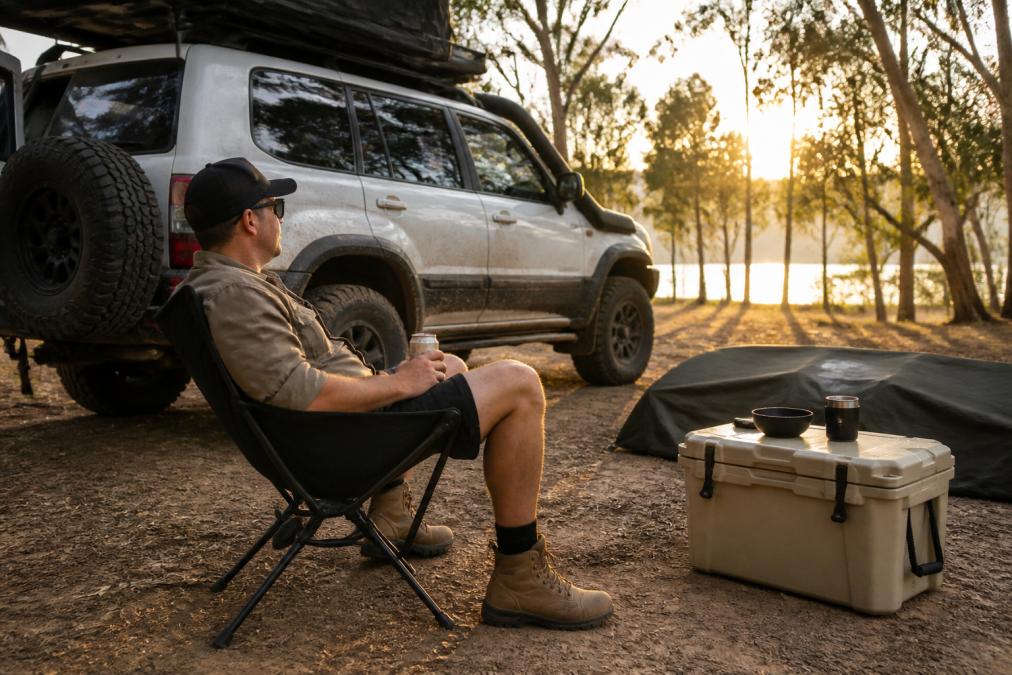
A chair that sits too low is hard to get out of and puts strain on your back. Look for a seat height that lets your feet rest flat and your knees sit around hip level. Lumbar support matters most if you or your partner have a bad back, because a chair with no curve at the base of the spine will have you shifting around within an hour.
Breathable mesh or ripstop nylon seats let air move, which matters on a 35 degree day. A padded seat feels great in winter and sticky in January.
Compact vs Full-Size: Which Chair Suits Your Setup
Compact and full-size chairs are built for different jobs, and the right answer depends on how you travel, not on which one is better.
Full-size car camping chairs are excellent for a week at one campsite. They are wide, heavily padded, often recline, and usually have a cup holder and side pocket. If you have the boot space and you are not carrying the chair far, that comfort is worth it.
Compact chairs suit a different trip. They fold small, carry light, and set up in seconds. They are the better pick if you are packing a wagon for a family trip, doing the big lap with limited storage, or walking to a spot.
| Your Setup | Best Fit | Why |
|---|---|---|
| Week at one campsite | Full-size padded chair | Maximum comfort, no carrying |
| Packed family wagon | Compact chair | Saves boot space |
| Hiking or festivals | Lightweight compact chair | Carries easily, sets up fast |
| Caravan or road trip | Compact chair | Fits limited storage |
If you mostly sit in one spot and space is not tight, a full-size chair is a great choice. If space and weight are the problem, go compact.
Climate and Ground Conditions: What Survives an Aussie Summer
Most camping chair guides are written as if every trip is a mild, dry day on flat grass. Australian conditions are not that. A chair that is perfect in a Darwin build-up is not the same chair you want on a frosty morning in the high country. Here is how to match the chair to the climate and the ground you actually camp on.
Hot and humid
Think coastal Queensland, the Top End, or a summer festival in the subtropics. The problem is not heat alone, it is sweat. A padded seat traps moisture against your back and legs, and after an hour you are peeling yourself off the chair.
What works:
- Breathable seat fabric. Mesh or ripstop nylon lets air move. Ripstop also resists the small nicks that come from rocks, zips and ute trays.
- A seat that drains. If it gets wet, it should dry fast. Foam padding holds water for days.
- Aluminium frame. It does not rust, which matters when you are near salt water or storing gear in humid air.
What to skip: heavy padding, dark colours that soak up sun, and anything that traps water in the seams.
Hot and dry
Inland summer is about UV and dust. Fabric fades and weakens under strong sun, and dust works its way into joints and zips.
- Keep the chair out of direct sun when you are not sitting in it. A shade cloth or the side of the vehicle is enough.
- Rinse dust out of the joints at the end of a trip and let everything dry fully before packing away.
- Powder-coated frames handle dust and knocks well. Aluminium alloy does not rust at all.
Cold weather
Cold changes two things. Fabric stiffens, and you feel the ground through the seat. A lightweight chair with a thin seat is fine in January and less fun on a frosty morning.
- A compact chair still works in the cold, but add a sit pad or a folded blanket for insulation.
- Set up on a mat or a piece of cardboard if the ground is frozen or very cold.
- Avoid forcing a stiff frame into position. Let it warm up a little first.
Wet and coastal
Salt spray and constant damp are hard on metal. Aluminium alloy is the easy answer here. Rinse the frame with fresh water after a beach trip, dry it, and store it dry. Ripstop nylon handles salt air well and dries quickly.
Ground conditions
Ground matters as much as weather.
- Sand. Narrow feet sink and the chair tilts. Wider feet spread the load. On soft sand, sit facing downhill if there is any slope at all.
- Soft grass or mud. Same story. Wide feet, and check the chair is not slowly sinking as the evening goes on.
- Rock and hard ground. Fine for any chair, but check the feet for wear. Hard surfaces are unforgiving on thin plastic feet.
- Slopes. Always face the chair downhill. Sitting sideways on a slope loads one side of the frame and is the fastest way to shorten a chair's life.
A note on repairability
Most guides ignore this, and it is the biggest gap in how people buy chairs. A chair you can repair is a chair you keep. When you are comparing options, ask a simple question: if the seat fabric wears out or a foot goes missing, can it be replaced, or is the whole chair landfill?
A chair with a replaceable seat and replaceable feet will outlast three chairs that cannot be fixed. That is better for your wallet and better for the tip. It is worth asking before you buy, whichever chair you end up with.
The short version
Match the chair to the trip. Humid trips want breathable fabric and no padding. Cold trips want insulation under you. Coastal trips want aluminium. Soft ground wants wide feet. Get those right and the chair will handle an Aussie summer, an Aussie winter, and everything in between.
Frequently Asked Questions
What should I look for in a portable camping chair?
Start with packed size and weight, then check the weight capacity and frame material. A chair that packs to around 44cm by 8cm and weighs under 2kg will fit in most boots and packs. Look for an aluminium frame rather than steel if carrying it matters, and ripstop nylon or breathable mesh for the seat. Setup time and stability on soft ground round out the list.
Are lightweight camping chairs durable enough for 150kg?
They can be, if the frame and fabric are rated for it. The Old Mate Original is built with an aluminium frame and ripstop nylon seat and carries a 150kg weight capacity. Check the stated capacity before buying rather than guessing, and remember that a chair rated to 150kg is designed to hold that load, not sit just under it.
How small can a portable camping chair pack down?
It varies a lot. Some fold to a long flat shape that still eats boot space, while compact designs pack much smaller. The Old Mate Original folds to 44cm long and 8cm wide, roughly the size of a drink bottle, which means it slides into a packed Commodore wagon or straps to the side of a hiking pack without a fight.
How do I choose between a compact chair and a full-size recliner?
It comes down to the job. A full-size recliner with padding, a cup holder and armrests is a great pick if you are parked at one campsite for a week and have room to store it. A compact chair suits hiking, festivals, sideline sports and packed cars. Both are good chairs, just for different trips, so pick the one that matches how you actually travel.
The hard part is not finding a chair. It is finding one that fits your car, your back, and your trip. Old Mate Camping Co. makes the Old Mate Original for exactly that: 1.8kg, packs to 44cm by 8cm, rated to 150kg, sets up in seconds, and comes with a one year manufacturing warranty and 30 day change of mind returns. If space and weight are your problem, get started with Old Mate Camping Co. and take a chair that actually comes with you.